

Disciplines in Hobby Horsing
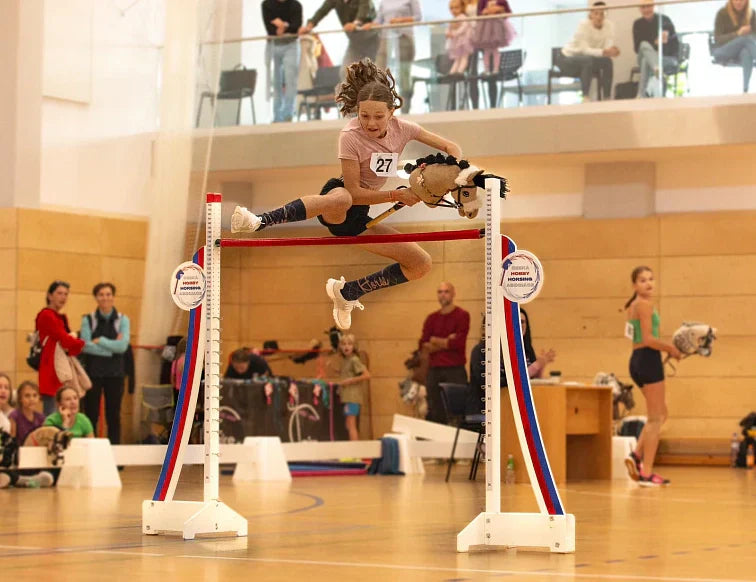
Hobby horsing is a relatively young sport that has quickly grown in popularity. It takes many hours of training and preparation to get ready for major competitions. There is something for everyone. To help you find your way, we introduce the individual disciplines below.

Dressage
Dressage is an elegant and popular discipline that places high demands on the rider. The rider must have control not only over their own body but also over the positioning of the Hobby Horse. The careful execution of individual elements, transitions, and the overall impression all contribute to the final score.
Before the start, the participant receives their test, which they must follow, and can practice all elements in advance. Among the most popular movements are the canter pirouette, piaffe, and passage. A tailcoat and hat worn by the rider add the finishing touch to the overall impression.
Show Jumping
A course consists of 8–12 different jumps arranged along a route. The layout and exact order of the jumps are announced in advance. You always have the opportunity to walk the course before the start. The course types mainly vary in the height and sequence of the obstacles.
Time, style, and completing the course without faults are the goals of a successful round. On a course, you will encounter obstacles such as oxers, verticals, triple bars, or walls.
Each course has a warm-up area where you can prepare for the competition and prevent injuries during the event.


Puissance
This is the most popular event of the competition day. The goal is to clear the highest possible jump without knocking down the barrier. The jump is performed in canter, with the horse’s stick touching the rider’s thigh at both takeoff and landing.
The round ends if the barrier is knocked down or the rider is disqualified. This discipline demands both experience and a healthy dose of courage from the rider.
Western Trail
In this western discipline, the rider completes a set course made up of various obstacles. These can include riding over cavaletti, opening and closing a gate, backing up, or navigating a slalom.
The course is usually designed so that the rider and Hobby Horse perform all three gaits – walk, trot, and canter – between the obstacles. The judge scores the performance based on accuracy and overall execution.


Horse Racing
The race is a competition with a maximum of six riders. Everyone starts at the same time, and once the starting tape drops, you get the green light.
You must always gallop on the track and hold your Hobby Horse so that the stick touches your thigh. Sometimes there are lower jumps included in the race that you must jump over. The first rider to cross the finish line wins.
Western Horsemanship
This discipline is often referred to as western dressage. Riders are evaluated on the accuracy of each movement as well as the overall impression.
To earn a high score, you need to master maneuvers such as halt, backing up, leg yield, half trot, turn on the forehand, turn on the haunches, flying lead change, sliding stop, and spin.
Riders may hold the reins in one hand or both. Wearing traditional western attire adds a polished and visually appealing touch to the performance.


