Each organizer can set their own rules. In most cases, however, Hobby Horsing tournaments follow the official association guidelines. Want to ride a clean, fault-free course? Here are five common mistakes in Hobby Horsing jumping, plus clear tips on what to focus on in training.

1. Knocking Down a Pole
A knockdown usually happens because of an incorrect take-off or an unsuitable jump height. The pole falls off the obstacle, which is one of the most common faults on a course. Depending on the organizer, a knockdown is scored with penalty points that add up during the round.
If there is a water obstacle in the course, stepping into the water is also considered a fault, both at take-off and at landing.
Knockdowns are part of the sporting development of almost every athlete. What matters is learning from mistakes and continuously improving your technique. That is what these Hobby Horsing tips are about.
2. No Canter in the Course
If you compete in a tournament, you should be confident in all three basic gaits: walk, trot, and canter. In a jumping course, however, canter is required throughout, including before take-off and after landing.
If cantering between obstacles is difficult, practising a lead change over the jump can help. You switch legs at the turning point and land on the correct lead. In performance-oriented competitions, walk or trot is not allowed and can result in penalty points.


3. Incorrect Order of Obstacles
Every course has a fixed direction and a set order of obstacles. They are numbered, usually from 1 to 8 or more, depending on the difficulty.
Before the start, all participants have the chance to walk the course. This course walk is especially important. You can measure distances, estimate take-off points, and memorise the sequence more easily.
If you ride the obstacles in the wrong order, you are usually disqualified immediately. Use every opportunity to walk the course. It is a key factor for a successful round.
4. Losing the Reins
The reins must be held in both hands throughout the entire course. Especially at landing or in an unstable moment, the reins can slip out of your hands.
As soon as that happens, judges award penalty points. Make sure you have a secure grip and train your stability, especially over jumps.


5. Incorrect Way of Holding the Hobby Horse
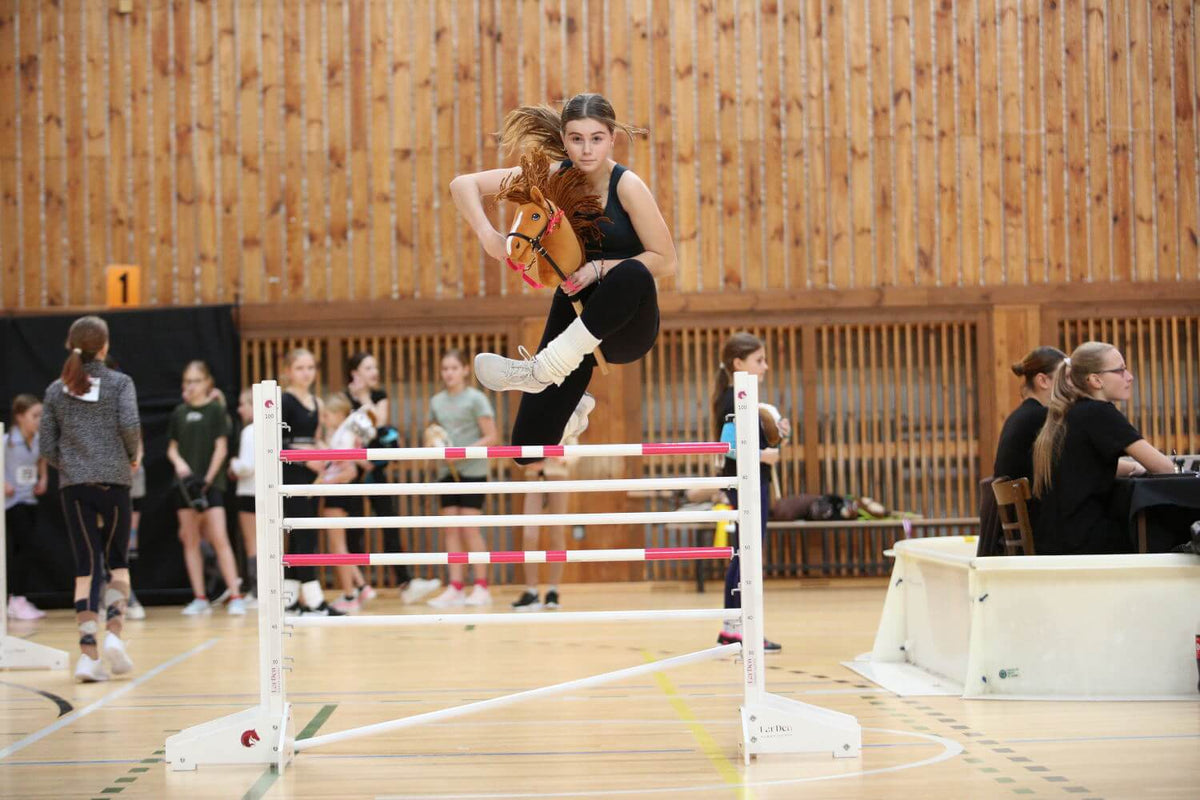
In jumping, the Hobby Horse must be held in one hand throughout the course. It must not be swung, lifted above your head, or stretched out to the side.
The stick must remain in contact with one point on your thigh at all times. In performance-oriented competitions, this is judged strictly. A strict judge may even disqualify you for incorrect holding.
This clearly shows how important the correct stick length is for a clean round.
Recommendation
One often underestimated factor in Hobby Horsing is choosing the right shoes. Many falls happen because unsuitable indoor shoes or barefoot shoes are worn. Especially in fast turns, slippery footwear can be dangerous.
This not only leads to unnecessary penalty points but also increases the risk of injury. 👉 Our recommendation: high-quality indoor sports shoes with a non-slip sole.